
Restore Georgia Opposes SB 468: Automatic Risk Classifications Undermine Evidence-Based Public Safety
Restore Georgia strongly opposes Senate Bill 468, legislation that would fundamentally alter Georgia’s sexual offender risk classification system by replacing individualized, evidence-based assessment with automatic offense-based designations.
Georgia currently operates a structured, risk-based classification system through the Sexual Offender Risk Review Board. That system evaluates individuals using empirically developed assessment tools and reviews dynamic and historical factors to determine actual risk to the community.
SB 468 shifts away from that model.
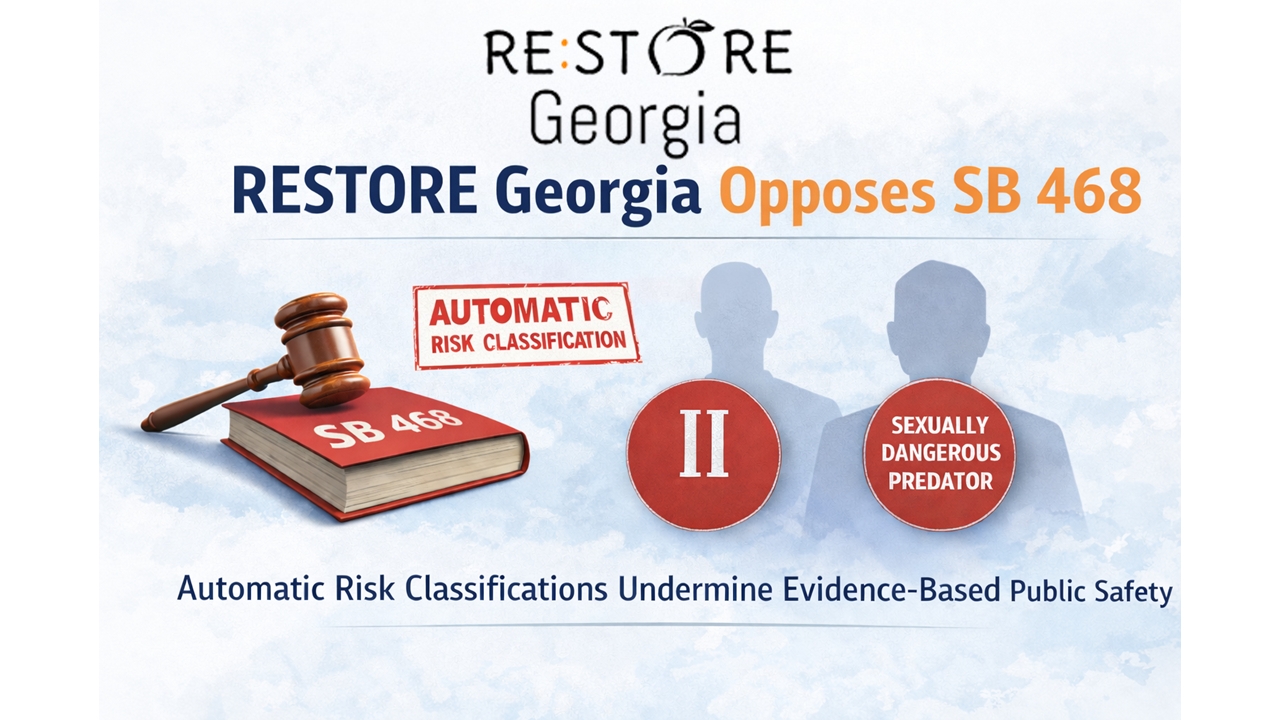
Under the bill, individuals convicted of certain offenses would be automatically placed into Level II or classified as “Sexually Dangerous Predator,” regardless of individualized assessment. Offense type alone would determine classification in specified cases.
This legislation replaces risk science with statutory assumption. Two individuals convicted of the same offense can present very different levels of future risk. Georgia’s current system recognizes that reality. SB 468 does not.
Replacing Risk Assessment With Automatic Labels
Modern risk assessment models rely on validated tools that evaluate multiple factors — including age, prior history, treatment participation, and behavioral indicators. Decades of criminological research demonstrate that individualized assessment is more accurate than offense-based assumptions in predicting recidivism.
SB 468 would mandate automatic classifications for certain convictions, bypassing that individualized review process.
If the concern is backlog at the Risk Review Board, the solution is increased resources and staffing — not eliminating individualized evaluation.
Increased Reporting Without Increased Safety
The bill also:
- Imposes heightened reporting requirements on homeless registrants, including a 12-hour window for reporting changes in sleeping location.
- Requires sexual offenders to report international travel 21 days in advance.
- Requires stable housing accountability programs to report accepted applicants who are registered sexual offenders to local sheriffs.
Additional housing reporting requirements may discourage participation in stable housing programs — a factor widely recognized as reducing recidivism.
Housing stability is one of the strongest predictors of successful reentry and reduced reoffending. Policies that destabilize housing undermine long-term public safety.
Protecting Children Requires Accuracy
Protecting children and communities must remain a top priority. The critical question is whether Georgia is using the most accurate and effective tools available to assess and manage risk.
Automatic labeling may appear decisive, but it is not necessarily precise. Georgia’s current risk-based system was designed to evaluate actual risk. SB 468 substitutes that evidence-based framework with offense-triggered classification mandates.
Accuracy strengthens public safety. Overgeneralization weakens it.
Constitutional and Structural Concerns
Expanding automatic lifetime designations such as “Sexually Dangerous Predator” without individualized assessment increases the risk of constitutional challenges, including due process concerns.
As registry schemes become more automatic and more restrictive, they risk being viewed as punitive rather than regulatory in nature, increasing legal vulnerability for the state.
A Better Path Forward
Restore Georgia urges lawmakers to:
- Fund and expand the Risk Review Board to reduce backlog;
- Preserve individualized risk assessment;
- Maintain evidence-based classification practices;
- Strengthen supervision resources without sacrificing accuracy.
Public safety is strengthened by precision. Georgia should reinforce its existing evidence-based system rather than replace it with automatic statutory mandates.
For more information, visit www.restore-georgia.org.